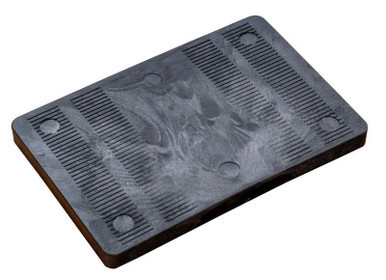
Mastagrid Geogrid 40 40 Poly
- SKU:
- GGPB4040
- Polyfabrics recommended the mastaGRID® Poly to provide sub-grade reinforcement under the crushed rock pavement, mastaGRID® Poly is a rigid biaxial geogrid commonly used for subgrade reinforcement, rock stabilisation and erosion control.


Loading stock status...
Description
mastaGRID® Poly is a rigid biaxial geogrid commonly used for subgrade reinforcement, rock stabilisation and erosion control. It is available in a range of strengths, while maintaining isotropic tensile strengths.
CHEMICAL & BIOLOGICAL RESISTANCE
mastaGRID® Poly is a biaxial geogrid manufactured from polypropylene which is unaffected by all chemicals, including acids, alkalis and salts, normally found in soils. It is not a nutrient, and therefore, unaffected by micro-organisms in soil.
MASTAGRID® POLY PROVIDES THE FOLLOWING BENEFITS:
- Distribution of loads and therefore reduction in stress concentration over the soil
- The geogrid’s structural junctions, rigid ribs and thick walls help lock aggregate, increasing its shear resistance
- As a result when a vertical load is applied the aggregate is restrained by the ribs reducing deformation. (Lateral Restraint)
- Decrease in long term deformation (Creep)
- Increase in load distribution. (Bearing Capacity Increase)
- Controls differential settlement
GEOTEXTILES VS RIGID GEOGRIDS
Rigid geogrids behave differently to woven & non-woven geotextiles. Geotextiles transmit stresses to the soil through friction. They do not interlock with the aggregate the same way as a rigid geogrid with the thick ribs. For a geotextile to provide reinforcement it must go into tension (Tension Membrane Effect) and for this to occur it requires large deformation and fixed wheel paths. This is difficult to control and design, as a result the only function it achieves is separation.
The transmission of stress between soil and geogrid is obtainable only if the geogrid is rigid with integral junction. A woven geogrid constructed of high tensile polymer strands, can hardly develop this function, as the structure is not integral and the transversal ribs can move along the longitudinal ribs without developing any interlocking effect. A properly chosen geogrid with angular rock is able to change the boundary conditions through three main mechanisms: (a) Confinement Effect (or Lateral Restraint); (b) Load Distribution and (c) Tension Membrane Effect.
Related Products
Related Products

Composite Geogrid 40 40 3.9x50m
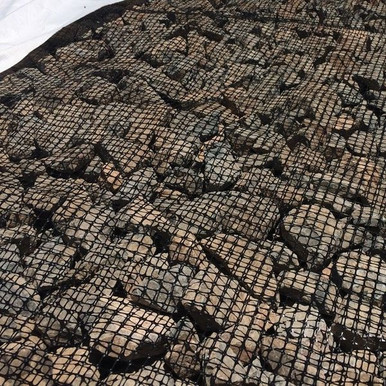

Rigid Biaxial Geogrid Poly 30kN 3.95x50m

Abrasive Sandpaper 40 Grit 120mmx50m
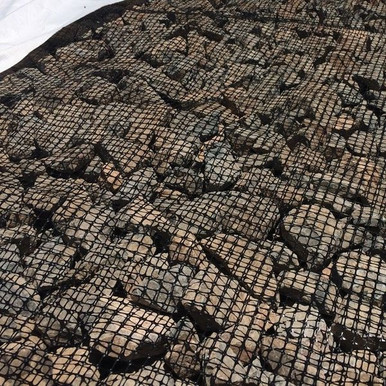

Rigid Biaxial Geogrid 20 20kn Poly 3.95x50m